Parshat Chukat-Balak Drash
27 June 2026
This week’s Torah portion opens with a statement: Zot Chukat HaTorah, this is a law of the Torah.
There are several ways to organize the 613 mitzvot of the Torah: we can sort them by positive versus negative commandments like Neil did on leil Shavuot; we can slice and dice the mitzvot by those between an individual and Hashem, versus mitzvot between people. We have public mitzvot and private mitzvot. And so on.
One of the classic ways to categorize mitzvot is to divide them into three categories: Mishpatim, Eduyot and Chukim.
A mishpat, which means judgment, is a common-sense law that humans, left to our own devices, would have enacted in the interest of a civil, orderly society: don’t murder, don’t steal, don’t move property boundaries. The “derp” ones, the obvious ones.
he next category, eduyot, which derives for the word Edut, testimony, are testamentary mitzvot which, although it is unlikely that we would have conceived of them on our own, they make perfect sense now that we have them: eat only matzah on Pesach, or living in huts for a week, or everyone taking one day off in seven to commune with Hashem.
The final category of mitzvot are called chukim, mitzvot whose purpose are not immediately discernible, but we perform these mitzvot with the same enthusiasm that we bring to the mitzvot we do understand. Why? Because as we said last week, we trust the Source. Examples of chukim are the laws of the red heifer, of which we read in our parshah, or shatnez, the prohibition of mixing linen and wool threads in a garment.
The word Chok derives from the word Chokek, to engrave, or perhaps from the word Chek, which means bosom. The idea is that precisely these mitzvot, the ones we don’t quite understand, should be engraved in our bosoms as being particularly precious to us, because we fulfill them for no other purpose that we are commanded to do so.
Most of us are familiar with the midrash in which Hashem presented the Torah to each of the Nations of the world, all of whom reject the Torah and its laws for various reasons: “pork and shellfish are the staples of our diet”; “we can’t live with not working on Shabbat”; “we can’t abide the laws of forbidden intimate relationships”. Circumcision? Ewww. Finally, the A-lmighty approached the Children of Israel, and presented us with the Torah. We immediately said “Na’aseh v’Nishmah, “we will do and we will listen.” Na’aseh: We made a commitment to perform all the mitzvot unconditionally, and only then – Nishmah, we would dig deeper, strive to understand the underlying meaning of the mitzvah.
Zot Chukat HaTorah, this is a law of the Torah. If you really think about it, on a very high spiritual level, every mitzvah is a chok, even if we understand the “whys and wherefores,” even if we get the deeper significance of the mitzvah. Because at the end of the day, we should be performing the mitzvot out of pure love for Hashem anyway.
Unfortunately, in the liberal Jewish world, the concept of Chok does not exist. Mitzvah observance is largely in the rear view mirror. The Reform proudly characterize their faith as the “Judaism of Personal Autonomy,” meaning that mitzvot are not commandments in the strictest sense of the word. If a mitzvah is meaningful to you, do it. If not, well, the Torah was written by dead, misogynistic, toxic white males anyway, so if we don’t care for a particular mitzvah, we are not bound by it.
Their religious schools teach children the most superficial understandings of Judaism: Rosh Hashanah? Apples and honey. Chanukah? Candles and donuts. Passover: Matzah. Shavuot? What’s Shavuot?
Is it any wonder that, as our children mature into adulthood, they look for more satisfying answers to their spiritual yearnings that they were never taught in their own faith tradition? Is it any wonder that they go off to college completely unprepared Jewishly for the world they will encounter? Is it any wonder that our children are seduced by the seemingly sophisticated philosophical and theological constructs of others, compared to their shamefully inadequate knowledge of their own faith?
Liberal Judaism is dying because it has abjectly failed to properly educate and retain the children. Rabbi Ammiel Hirsch is the senior rabbi of Stephen Wise Free Synagogue in New York City. Last Rosh Hashanah, he asked publicly, from the pulpit, why it is that the leadership of all the left-wing anti-Zionist organizations like Jewish Voices for Palestine and J-Street are largely products of the Reform Movement.
The question answers itself.
Please look at the handout I distributed today.
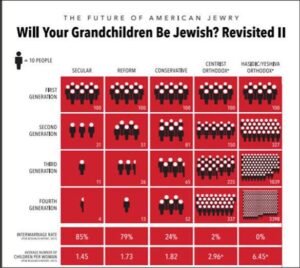
Start with the infographic entitled “Will your grandchildren be Jewish?” Please study this infographic carefully.
You will first notice that secular Jews, the leftmost column, who constitute 43% of American Jews have an 85% intermarriage rate and a very low, unsustainable CPW ratio. So if you start with 100 secular Jews, you’ll only have 4 Jews left three generations later. The rest? assimilitated into oblivion.
The Reform don’t fare much better, with 79% intermarriage rate and 1.73 children per woman. If you start with 100 Reform Jews, you’ll be left with13 Jews three generations later.
The Conservative Movement is also unsustainable. 24% intermarriage rate, 1.82 CPW ratio. If you start with 100 Conservative Jews, about half will have Jewish great-grandchildren. 52% is a failing grade by any measure.
But it gets worse.
- 12% of Jewish households self-identify as Conservative; 20 years ago it was 33% and 40 years ago it was closer to 50%.
- 70% of Conservative Jews are 50 or older; 43% are 65+
- 9% of 18-29s identify as Conservative
- 35% of 18-29s identify as Orthodox – more than Conservative and Reformed combined
The conclusion is ineluctable: Conservative Jews are rapidly dying out and there are scant few young, committed Conservative Jews to replace them.
Liberal Judaism is dead Judaism.
The medicine to save the patient is a return to Torah values and authentic Jewish living. Since I began my work here, I have been forcefully advocating for a shift from liberal Conservative Judaism to Traditional Conservative Judaism, or simply Traditional Judaism. I prefer not to use the term “Conservative”, because it is a toxic, dying brand that attracts almost no one.
What is Traditional Judaism? Please flip the handout to the table on the other side.

The first thing you will observe is that, by any metric you choose, today’s Conservative Movement is virtually identical to Reform Judaism on the issues. The few differences that exist today between the Conservative and the Reform are minor differences of style, not of substance. This data goes a long way to explain why Conservative Judaism is dying. It is collapsing under the weight of its own political correctness.
And two years ago, this synagogue was headed in the same direction – oblivion.
This chart also defines Traditional Judaism for those who may be unclear on its definition: with the exception of egalitarianism and family seating, this congregation will conform to the settled standards of Jewish Law.
My goal is to return it to the halcyon days when Conservative Judaism was a Lighthouse of Torah; a proud synthesis of uncompromising Tradition engaging with modernity. We occupy that broad, middle swath on the spectrum of Jewish observance that has been ceded by Modern Orthodoxy, which has tragically shifted very far to the right.
I hearken back to the great luminaries in the Conservative constellation: Rabbi Solomon Schecter; Rabbi Saul Lieberman; Rabbi Avraham Yehoshua Heschel; Rabbi Louis Finklestein; Rabbi Louis Ginzberg; Rabbi David Weiss HaLivni.
Every single one of these great rabbis were experts in talmud and Jewish law, and were strictly Shabbat and mitzvah observant. When these great luminaries led the Conservative movement, it flourished; at one point in the ‘70’s, there were more Conservative congregations than Reform in the US.
I’d like to share a quote from Rabbi Ginzberg. If you’ve never heard of Rabbi Louis Ginzberg, he authored, among many other books, the Legends of the Jews, a multi-volume text on the Midrash. He began teaching the Talmud at the Jewish Theological Seminary from its reorganization in 1902 until his death in 1953. During this time, he trained two generations of future Conservative rabbis, influencing almost every rabbi of the Conservative movement in a personal way. Ginzberg was highly praised by his colleagues; JTS leader Louis Finkelstein described him as a “living symbol of love for Torah.”
He wrote: “The conception that in religious matters anyone, however ignorant, can judge for himself, is the direct denial of the old Jewish maxim, ‘Lo Am HaAretz Chasid,’ ‘The ignorant cannot be pious’ (Avot 2:5) … The majority vote of a Board of Directors of a synagogue is, after all, a negligible quantity when it is in opposition to the vote of Torah Judaism…decisions of Jewish law can only be made by experienced hands.”
In other words, if, by a unanimous vote of the synagogue board, they decide ham is now kosher, and demand the rabbi eat it – what should the rabbi do?
And just for the record, Rabbi Louis Finklestein, Chancellor of the JTS from 1940 to 1972, recited his prayers before he attended a Conservative synagogue, just like someone else of your acquaintance.
In 1986, the Conservative Movement published Emet vEmunah, a statement of the principles of Conservative Judaism. Few if any of you have read it, despite my urgings to do so. If you ever do read it, you will find that nowhere in the document does it state that Conservative Jews are exempt from mitzvah performance. Conservative Jews are just as bound to mitzvah performance as the black-hattiest Satmar chusid in Brooklyn, because the Torah and its laws are the common heritage of the entire Jewish People. Conservative Judaism, contrary to the common misconception, is not Orthodox “lite,” nestled somewhere between Orthodox and Reform.
But there’s a huge, gaping chasm between what is and what should be. Most American Jews can’t even cogently articulate the main beliefs of our faith. As sociologist Nathan Glazer noted: “Because most American Jews are incapable of giving a coherent statement of the main beliefs of the Jewish religion, they tend to call ‘Judaism’ whatever they happen to believe in today.” In other words, people unschooled in Jewish law erroneously define Judaism however they see fit.
In 2015, another sociologist, Steven Cohen, studied why the Orthodox are successful in retaining their children and expanding their numbers while liberal Jews are assimilating to extinction. He distilled it down to the acronym PRICE:
- P – That is, they exhibit extraordinary Passion about Jewish norms and purpose.
- R – They perform numerous religious Rituals.
- I – They maintain high rates of Informal association (more spouses, friends, and neighbors who are Jewish).
- C – They engage in Community — be it in synagogues, organizations, charities, or pro-Israel political activity.
- E – And they undertake Educational activities, be it learning groups for themselves or sending their children to day school, overnight camps or to Israel for a very influential gap year.
Importantly, he concludes that Conservative Jews who follow the same path exhibit extraordinary success in raising their children as committed and active Jews. Barry & Lori Ripps are fine examples of such Conservative families.
The question before us is a simple one: does B’nai Israel Synagogue wish to thrive or die? Will we choose the path of Torah, Tradition and Halacha and continue to thrive and grow? Will this congregation become relevant again? Will this congregation be a part of the Jewish future? Of Jewish destiny?
Or will we choose the dead-end path of make-it-up-as-you-go, anti-Halachic liberal Judaism and pleasantly fade away? Liberal Judaism is accomplishing the destruction of the greatest Jewish diaspora since the Golden Age of Spain.
There is no question more important for the future of B’nai Israel Synagogue.
If we cling to our liberal Jewish notions of what we think Judaism should be, run with every trendy innovation, we will surely perish. Liberal Jews have abandoned Halachah and have therefore forfeited the protections of the G-d’s Divine Covenant with the Jewish People.
On the other hand, by choosing the path of Traditional Judaism, of staying under the umbrella of halacha and mitzvah observance, we return to the viable, successful Judaism of our forebears. Our commitment to Traditional Judaism will build this congregation to spiritual heights that have not been seen in Pensacola in 100 years.
Zot Chukat HaTorah, this is a law of the Torah. Jewish Law matters. Jewish Law is not whatever you think it is. For us, Jewish Law is our oxygen. As we say daily in our evening prayers: “because the mitzvot are our very lives and the length of our days; we will pore over them day and night.”
No one explained the crossroads we face today better than Moshe himself:
“See, I set before you this day life and good, death and evil. For I command you this day, to love the ETERNAL your G-d, to walk in His ways, and to keep His commandments, laws, and chukim—that you may thrive and increase, and that the ETERNAL your God may bless you in the land that you are about to enter and possess. But if your heart turns away and you give no heed, and are lured into the worship and service of other gods, I declare to you this day that you shall certainly perish; you shall not long endure on the soil that you are crossing the Jordan to enter and possess. I call heaven and earth to witness against you this day: I have put before you life and death, blessing and curse. Choose life. (Deuteronomy 30:15-20)
B’nai Israel Synagogue has been thrown a lifeline, to save it from the ruin of liberal Judaism.
It remains to be seen if the congregation will display the wisdom to grab that lifeline.
Shabbat Shalom.
************************
Parshat Korach Drash 5786
“The Candy Store”
Korach was one clever cookie.
By dangling plums of power and glory, he cobbled together a rebellion from the most improbable group of malcontents: (1) some firstborns among the various Tribes of Israel, who sought the restoration of the traditional priesthood to the eldest sons; (2) some Reubenites, who, as descendants of Jacob’s firstborn son Reuben, felt entitled to the priesthood; and (3) some Levites, who were dissatisfied with the support role they were assigned in G-d’s service, and coveted the priesthood for themselves.
These rival factions had competing interests and could agree on nothing – except that the High Priest Aaron (and his sons the Cohanim) had to go. We see this same phenomenon today in Israel, where political enemies, who would otherwise be attacking each other, find themselves rallying around one cause – anyone but Netanyahu.
Korach knew that he couldn’t possibly keep his promises to them all, but no matter: like most slick politicians, he never intended to anyway. They were merely useful idiots, props in the advancement of his secret ambition: a coup d’etat to topple Moses, to be replaced by none other than – Korach himself.
And why not? Korach was rich where his first cousin Moses was not; charismatic where Moses was reserved and serious. (Korach probably had whiter teeth, fresher breath and could bench press twice his body weight, too.)
But for all his advantages, Korach, as his name implies in the Hebrew, was cold as ice and just as slippery and calculating. Wealth made Korach insufferably arrogant (as wealth invariably does), and his natural charisma drove his limitless ambition.
At the heart of Korach’s rebellion is a question which bears heavily on Jewish life to this day: What is the purpose of religion? To serve G-d, or is religion meant to serve us?
Korach stroked the egos of the insurrectionists by arguing that the purpose of religion was to serve them: after all, “kulam kedoshim,” all the people are holy. Accordingly, Moses’ Lawbook should be edited to conform to the evolving needs and aesthetic sensibilities of the people.
In this view, the synagogue is a spiritual service center, where people turn to have their afflictions comforted, their marriages sanctioned, their dead buried, their children bar-mitzvahed. And just like the local tire shop or dry cleaner, you don’t give the place much thought when you aren’t in need of the services they provide.
This consumerist view posits that religion is like powerful medicine: good to know it’s there when you need it, but who takes antibiotics if you don’t have a bacterial infection? Who takes Dayquil if you don’t have the flu?
In the spiritual marketplace, the customer is king – and it’s a buyer’s market. Is your rabbi coming down a little hard on your lifestyle choices? No problem, go rabbi shopping! There are boatloads of others, one of whom is sure to grant religious sanction to anything – and I mean absolutely anything – your little heart desires, and all for the most reasonable of fees.
As savvy consumers, Korach and his motley crew were merely trading up – on both Moses and Aaron.
By contrast, Moshe, the eved Hashem, the servant of G-d, embodied the opposite view: that the religious life is a life devoted to service, first to G-d and, by extension, to our fellow man.
Avodah, service, is all about performing G-d’s mitzvot with joy. Avodah is recognizing that the mitzvot come from G-d through Moses, but not from Moses himself. (This, by the way, was one of Korach’s accusations against Moshe: that he was making all these laws up himself and was not in communication with G-d at all.) It’s about performing the mitzvah even if we don’t fully understand why (and even as we resolve to gain deeper understanding) because we trust the Source. Avodah is about loving G-d by doing His mitzvot with all your heart and all your soul and all your might. (where have we heard those words before??)
In other words, true piety is not about calculating the take, the benefits that we extract from our religious experience as a spiritual consumer. It has been said that everyone’s favorite radio station is WII-FM – What’s In It For Me? Not so in Judaism. Rather, it’s all about the moment-to-moment hard work of spiritual growth and development, of giving our hearts to G-d, quietly and without fanfare.
“Antigonus the leader of Socho said: be not like servants who serve their master for the sake of reward; rather, be like servants who serve their master [out of love and] without expectation of reward.” (Pirkei Avot 1:3)
This contrast between Moshe’s and Korach’s view of the utility of religion is explicitly reflected, again, in Pirkei Avot (5:17):
“Every argument that is for the sake of heaven is destined to endure. But if it is not for the sake of heaven — it is not destined to endure. What is an example of an argument for the sake of heaven? The legal arguments between Hillel and Shammai. What is an example of an argument not for the sake of heaven? The argument of Korach and all of his followers.”
Korach wasn’t casting his eyes heavenward, in the service of G-d, he was casting his eyes downward, dispensing candy to the Israelites. Moses had nothing to offer them but spinach and hard work.
Which is easier to sell?
Tragically, there is a lot of candy on offer in the Jewish world today. We live in a time when it has become fashionable to modernize Judaism with all kinds of updates and tweaks and improvements.
The thorny problem is Moses’ Lawbook, which is an insurmountable obstacle to the new-and-improved Judaism version 2.0. So “Job One” must be to delegitimize the Torah, undercut its authority. Then we can begin crafting a Judaism more adapted to our own likeness and image.
Is the wording of a particular prayer giving you heartburn? A little liturgical nip-and-tuck is in order. Trim the fat. Cut out the parts you don’t like, or better yet, write your own prayer book, which reflects your uber-sophisticated modern sensibilities (because let’s just come out and say it – it’s all about you.)
Don’t like a particular mitzvah? Cut and paste it out of the Book. Better yet, chuck the Torah out the window altogether and design your own customized faith system. Invent your own mitzvot. Environmentalism replaces kosher. Feminism in place of Shabbat. Gay Rights instead of Circumcision. Then head out to the marketplace where you’re sure to find a rabbi to call it “Judaism.”
And so we witness the phenomenon of so-called rabbis who possess no grounding in the sacred, primary texts of our faith; who don’t know how to read from the Torah or study the Talmud in the original. Rabbis whose rabbinic training consists of sensitivity training and advocating for the poor, hapless Palestinians and globalizing “social justice” and couching your anti-Zionism as a Jewish value.
And the DEI thought-police demand that we treat both authentic rabbis and bubblegum rabbis with the same deference and respect. Candy corn and real corn are both corn, right?
The Edward Scissorhands routine has become so pervasive in American Judaism that it becomes harder by the day to find the simple faith of our forbears, that dedication to Absolute Truth, so nobly embodied for all generations by Moses. Those very things that have saved us alive through 18 centuries of exile and persecution are now being thrown overboard with gay abandon. Is it any wonder why Liberal Judaism is in its death throes?
To the contrary: Judaism is not consumer driven; it is not transactional. There is no pluralism in authentic Judaism. What there is is a rich and fascinating diversity in customs and traditions related to mitzvah performance. At the end of the day, though, there is but One G-d, One Torah and One Jewish People.
Ours is a text-based faith, and our primary texts constitute the terms of our Covenant with the A-lmighty. When we live under the authority of the Written and Oral Torah, those texts having been distilled down to Halacha, the practical guide to day-to-day Jewish living, we accrue the benefits of that Covenant. Those Jews who, in their unbounded arrogance, deign to change G-d’s law to suit the prevailing cultural fads and trends fall outside the pale of that Covenant and are ultimately lost to Jewish history.
I, for one, do not believe that our liturgy requires updating. Our liturgy is 2500 years old; some prayers are even older and can be traced back to the Moshe. Every rabbi in subsequent generations endorsed these prayers. The authors of these traditional texts were far smarter, more learned and holier than anyone in this room, indeed, anyone living today. Each sentence was carefully constructed, each word deliberate. The concept is called Emunat Chachamim, a certitude that the sages have always acted in good faith and with their eyes on Heaven. Perhaps, instead of editing the texts, we should be self-editing, that is, changing and growing ourselves…
This is what Moshe meant when he inveighed us to do what is right in G-d’s eyes – rather than doing what is right in our own eyes.
Ultimately, G-d had to directly intervene in the rebellion of Korach to remind people that the heart of the Jewish faith system does not revolve around the desires of the Jewish People, but around our service of G-d. Our Covenantal relationship with G-d is a contingent one.
To clarify that point: the bond between the People of Israel and the G-d of Israel is irrevocable. As the verse states:
“Despite all your backsliding, when you will be exiled to the land of your enemies, I will not be completely revolted by you and reject you totally to the point of abrogating my Covenant with you – for I am Hashem, you G-d. “(Leviticus 26.44)
But for us as individuals, our Covenantal relationship is absolutely conditioned on our mitzvah performance. It is a sad reflection on us that many of our non-Jewish Noahide friends understand this concept better than some native Jews. G-d bless them and may their numbers continue to grow.
Korach was literally swallowed by his own ambition, and his rebels destroyed. But as the parsha goes on to tell, the ripples of that rebellion spread in their time and in ours.
Candy tastes good going down, but you will get sick and die if candy is your only food. Snickers doesn’t satisfy.
So it should come as no surprise that many Jews are rejecting the spiritually empty junk food on which they were weaned in their suburban temples and are returning to the not-so-politically-correct tenets of our faith.
I recently met a man who felt obligated to tell me right up front that he was a confirmed Reform Jew, although he hadn’t been to temple in decades. He went on to describe his family’s horror as a favorite nephew had started keeping the mitzvot, and would no longer eat non-kosher food or work on Shabbat. He described it to me with the same shock and confusion as if the young man had been abducted by an exotic religious cult.
Hundreds of thousands of Jews like the nephew have abandoned the emptiness of liberal Judaism to discover the rich spiritual nutrition of Avodah, coming to realize that you cannot feed your soul from someone else’s garden. This, too, is the fulfillment of Biblical prophecy.
“Behold the days are coming, saith the L-rd, when I will send a terrible famine in the land; not a hunger for bread or a thirst for water, but a hunger to hear the authentic words of Hashem.” (Amos 8:11)
Judaism has never been a populist movement. We are, and will continue to be, the least among the nations. It has been our historical role to stand against the ever-changing and usually debased social mores of our host cultures, NOT to give them religious sanction. Judaism was the original counter-culture, and in many ways still is. We march to the beat of a different drummer.
Abraham and his stubborn monotheistic ideas were a pain in the rear to Nimrod and the Sumerian pagans; we Jews were a headache to the polytheistic Greeks, and to the Romans after them. Today, Woke, non-binary definitions of gender are enjoying their moment in the sun; and, in so doing, have rendered the darling causes of yesterday, radical feminism and militant gay advocacy, pretty much irrelevant. Tomorrow it will undoubtedly be something new and even more provocative. And to be sure, in every generation there have been Jewish hellenizers, appeasers, reformers, modernizers; people who run with every new passing fad & trend by trying to label it “Jewish.” But in every generation these types fall away, largely forgotten by Jewish history.
A feel-good Judaism defined by what is popular or trendy or lucrative is not Judaism, it’s mob rule. History has taught us again and again that only the Torah and its adherents endure. “Etz chaim hee lamachazikim bah,” the Torah is a Tree of Life to those who choose to cling to it. B’nai Israel Synagogue, I am proud to say, clings to those values, which is why we will not only survive but thrive.
Today as always, guided by Torah, Jews stand as the conscience of the world. The Jewish universalist vision of an ethical, compassionate monotheism has much to contribute to the ongoing social dialogue and to the ethical refinement of humankind. And if, by teaching an authentic, unadulterated Torah message, rabbis must speak in opposition to the latest and greatest cultural verities, then so be it.
“Trust in G-d; take heart and have courage; and above all, trust in G-d.”
Shabbat Shalom.